

PROPERTY NEWS
Property worth £1 million or more in London continues to make a comeback as the world adjusts to life alongside the
coronavirus pandemic – with house prices up and discounts down.
Prices have risen particularly well in areas outside central London, such as Richmond, Wandsworth and Islington, as we see a ‘race for space’ brought on by the pandemic.
This has created an opportunity for those looking to buy centrally as some areas are currently pretty cheap compared to historic levels. Prices in Knightsbridge & Belgravia, for example, are 17 per cent below their peak in 2014.
That may not last though, with many UK property agents predicting significant growth in central London’s luxury housing market this year.
Peter Flavel, CEO, Coutts, says, “The market for properties worth £1 million or more in London is well and truly on the rebound, having been in the doldrums over recent years. Prices are up, with new records set in some areas, and the amount buyers are getting off the asking price is dropping.
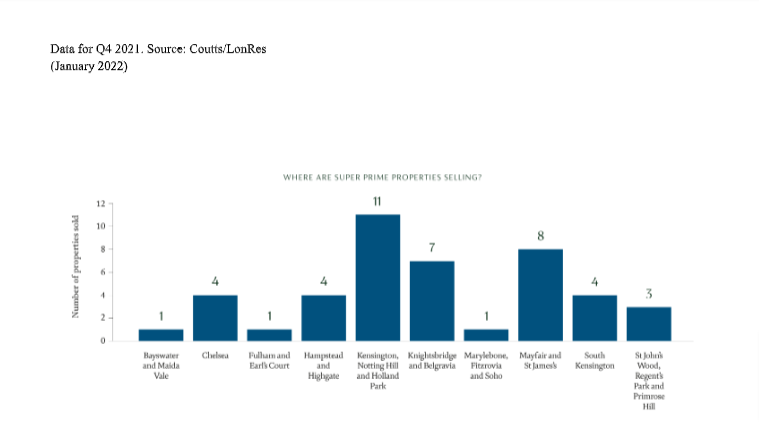
“Kensington, Notting Hill and Holland Park have been the most active in the over £10m price bracket, while King’s Cross and Islington have seen rises of 12 per cent over the last 12 months.”
He adds, “The pandemic has forced many to rethink what they want. Clients are looking for more space, a bigger garden, and a home office. To get all that, many have been forced to move out a little further, and the resulting demand in those areas has caused prices to shoot up.
SUPER PRIME SALES SURGE
Meanwhile, the market for super prime properties – those worth £10 million or more – has skyrocketed.
Sales have doubled in 2021 compared to the previous year, and from October to December we saw the highest number sold in any three-month period since 2016.
Katherine O’Shea, Director, Coutts Real Estate Investment Service, says, “There appears to be a sense of opportunity as super prime buyers take advantage of a central London market that’s had pretty stagnant growth for a number of years.
“For many investors there’s a desire to put funds into assets they can enjoy; for others it’s simply about investing in real assets that appear cheap compared to historic prices.”
THE MARKET IN NUMBERS
The latest numbers and analysis on luxury London property come from our regular review of the market – the Coutts London Prime Property Index (CLPPI) – which reveals overall trends and what’s happening area-by-area (see below).
Key highlights for the last three months of 2021 include:
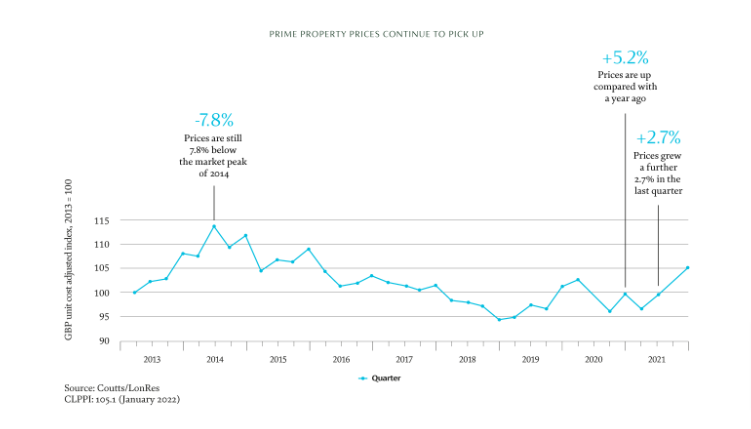
- Prime property prices increased 3 per cent, which brings annual house price growth to 5 per cent – driven mainly by outer prime London markets
- Prices are still low historically though – currently 8 per cent below what they were when the market peaked in 2014
- Super prime (£10m+) property prices have risen 11 per cent in the last year
- Over a third of high-end London property is being sold at a discount but buyers are getting less off the asking price – around 7 per cent compared to 8 per cent the previous year, and 13 per cent three years ago
- The number of properties available for sale has dropped – down 17 per cent on the previous year – and new listings are down 12 per cent
- The difference in price between central London and other parts of the capital has shrunk dramatically – four years ago central property prices were over 70 per cent more expensive than outer prime markets, now they’re roughly 58 per cent pricier.
What is the difference between a real estate agent and a real estate broker?
Most states require real estate sales professionals to be licensed by the state, so that they can control education and experience requirements and have a central authority to resolve consumer problems.
The terminology used to identify real estate professionals varies a little from state to state. Brokers are generally required to have more education and experience than real estate salespersons or agents.
The person you normally deal with is a real estate agent or salesperson. The salesperson is licensed by the state, but must work for a broker. All listings are placed in the broker’s name, not the salesperson’s.
A broker can deal directly with home buyers and sellers, or can have a staff of salespersons or agents working for him or her.
Why should I use a real estate salesperson?
A real estate salesperson is more than just a “sales person.” They act on your behalf as your agent, providing you with advice and guidance and doing a job – helping you buy or sell a home. While it is true they get paid for what they do, so do other professions that provide advice, guidance, and have a service to sell –such as Certified Public Accountants and Attorneys
The Internet has opened up a world of information that wasn’t previously available to homebuyers and seller. The data on listings available for sale is almost current – but not quite. There are times when you need the most current information about what has sold or is for sale, and the only way to get that is with an agent.
If you’re selling a home, you gain access to the most buyers by being listed in the Multiple Listing Service. Only a licensed real estate agent who is a member of your local MLS can get you listed there – which then gets you automatically listed on some of the major real estate web sites. If you’re buying or selling a home, the MLS is your agent’s best tool.
However, the role of an agent has changed in the last couple of years. In the past, agents were the only way home buyers and sellers could access information. Now agents are evolving. Because today’s home buyers and sellers are so much better informed than in the past, expertise and ability are becoming more important.
The real estate agent is becoming more of a “guide” than a “salesperson” — your personal representative in buying or selling a home.
I have a family friend who is a Realtor. I like her and she is a help but she gives me one price to sell my home for and I think it is too low. So I called another agent who suggested a price more in line with my expectations. Who do I choose?
You might want to consult a couple more Realtors on the market value of your home. Most of the estimates should be in the same ballpark.
It could be that your friend is being more honest with you about the value of your home and the other Realtor gave you a higher number because he already knew you expected it. This is called “Buying a Listing” and is the subject of an article on our web site.
Or it could simply be that your friend is a good friend, but not that great of a real estate agent.
Mixing business and friendships is always risky to the friendship. On the other hand, if your friend is truly competent and was providing wise advice, she may be offended if you ignore the advice and choose another agent.
I have to make a choice between an updated home in an older neighborhood or a newer home in a more modern neighborhood. The home in the older neighborhood has almost everything I want and is much larger, but which makes the most sense as an investment?
If your goal is to buy a home for it’s resale value and the one you are thinking of buying in the older neighborhood is at the upper end of values for that neighborhood, then it may not be the wisest choice. If it is similar or lower in price to the others, then there should be no problem, because pricing should be considered in relation to the local neighborhood and not compared to homes in other neighborhoods (for the most part)
Plus, is it a neighborhood on the decline, or are others going to be fixing things up, too, so that it is a neighborhood that is improving? It could turn out to be a very good deal as long as you don’t “overpay” because of the recent improvements.
Remember that you also buy a home for it’s value to you as a “home,” and that is something else you should consider. Which neighborhood would you AND your family feel most comfortable in?
When buying a new home, what upgrades should we go for? What holds the most value? Do we upgrade the lot? Pick more square footage in the house? Add an extra bedroom?, etc.
A lot depends on why you are buying the house. Are you buying it mostly as a home or mostly as an investment? There is a difference.
For the most part, upgrades are high-profit items for builders. They aren’t designed to enhance the value of the house, but make you happier with the house you do buy.
If you are looking at your home as an investment, then you buy from the smaller to medium size in the tract and spend only a minimal amount on upgrades. If you are looking at your purchase as a home, then you select upgrades that will enhance your quality of living.
One rule of thumb is to always upgrade the carpet and padding.